2025 · Built & driven
Project
Arceus-4G
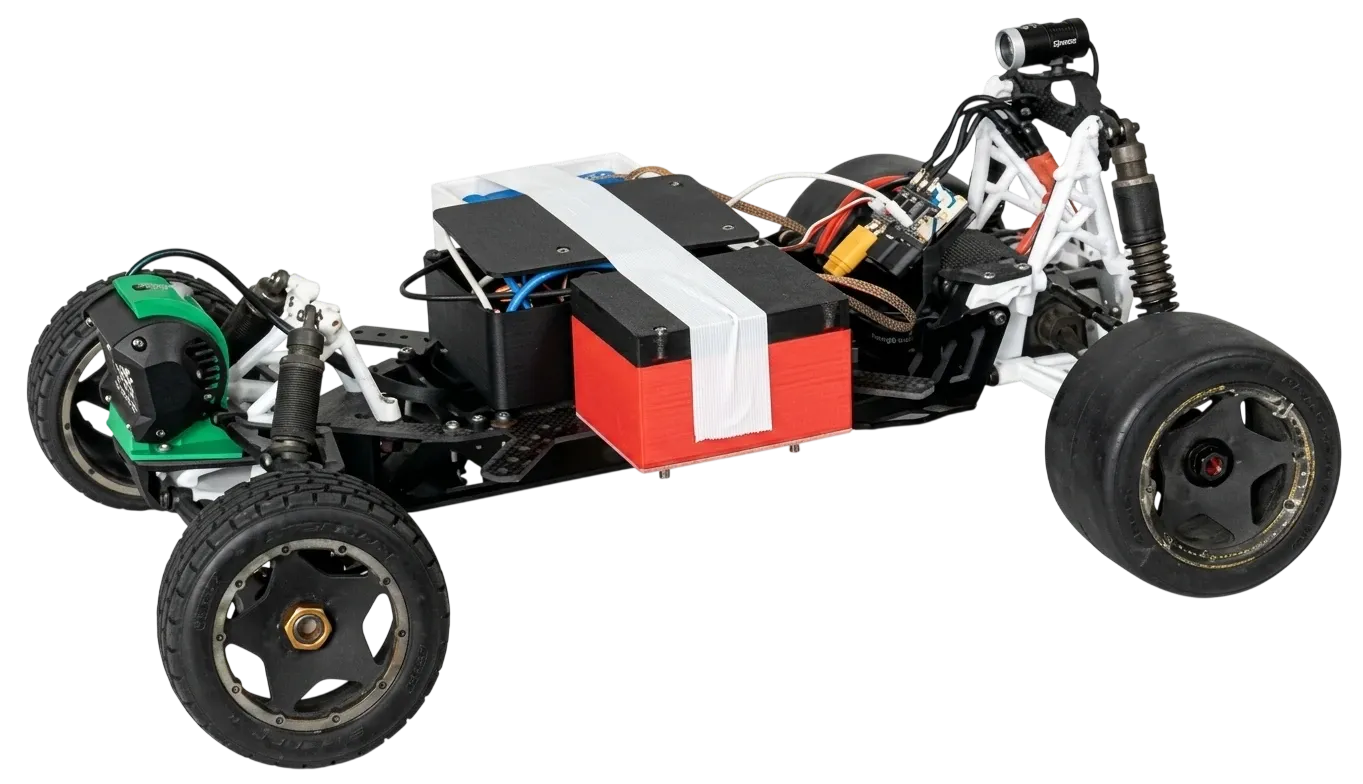
A remote controlled car with no range limit. Not a longer-range radio: no radio at all. The car carries a 4G modem and talks straight to the driver’s PC over the internet, so the only ceiling left is cell coverage.
The problem
Radio range is the wrong thing to fix.
Every RC car eventually hits the same wall: the controller and the car have to hear each other. You can push that wall further out with better antennas and more power, but it is still a wall, and it still ends at line of sight.
Arceus-4G removes the wall instead of moving it. If the car has a mobile connection and the driver has an internet connection, the two can find each other, whether they are on the same street or on different continents. The interesting engineering is not in the chassis. It is in getting two devices that both sit behind carrier-grade NAT to talk directly.
How it works
Punching a hole through the carrier.
Mobile networks put subscribers behind carrier-grade NAT. You get no public address, and nothing on the outside can open a connection to you. The usual answer is to relay everything through a server in the middle, which costs money and adds latency to every frame. Arceus-4G does not.
- 01
Both ends check in
The car and the driver’s PC each contact a lightweight rendezvous service. It does exactly one job: swap the public IP and port pair that each side appears as from the outside. It never carries video or control traffic.
- 02
Both ends spray
Knowing each other’s pair, the two endpoints fire UDP at one another simultaneously. Each outbound packet punches a hole in its own NAT, so the other side’s packets find an open mapping waiting when they arrive.
- 03
The path goes direct
From then on, traffic flows straight between car and driver. Nothing sits in the middle to add latency or cost, which is what makes the range limit disappear: there is no infrastructure to be far away from.
- 04
It stays up
Periodic keep-alives hold the NAT mappings open through idle moments, and the link re-establishes on its own when mobile coverage drops out. Backpressure management stops stale frames queueing up behind a stall.
Specification
What is on the car.
- Link Custom UDP hole-punching protocol
- Topology Direct peer-to-peer, no media relay
- Carrier 4G, through carrier-grade NAT
- Video Two streams: forward primary and wide situational
- Encoding Adaptive bitrate, degrades rather than stalls
- Control Any HID device: gamepad, wheel or keyboard
- Recovery Keep-alives plus automatic reconnect
Arceus-4G was built and documented by Andreas Lindeman. The full technical write-up, including the demo footage, lives at andreaslindeman.com.
Sponsorship
The next one needs funding.
Arceus-4G was paid for out of pocket. Project Mobula does not have to be.